




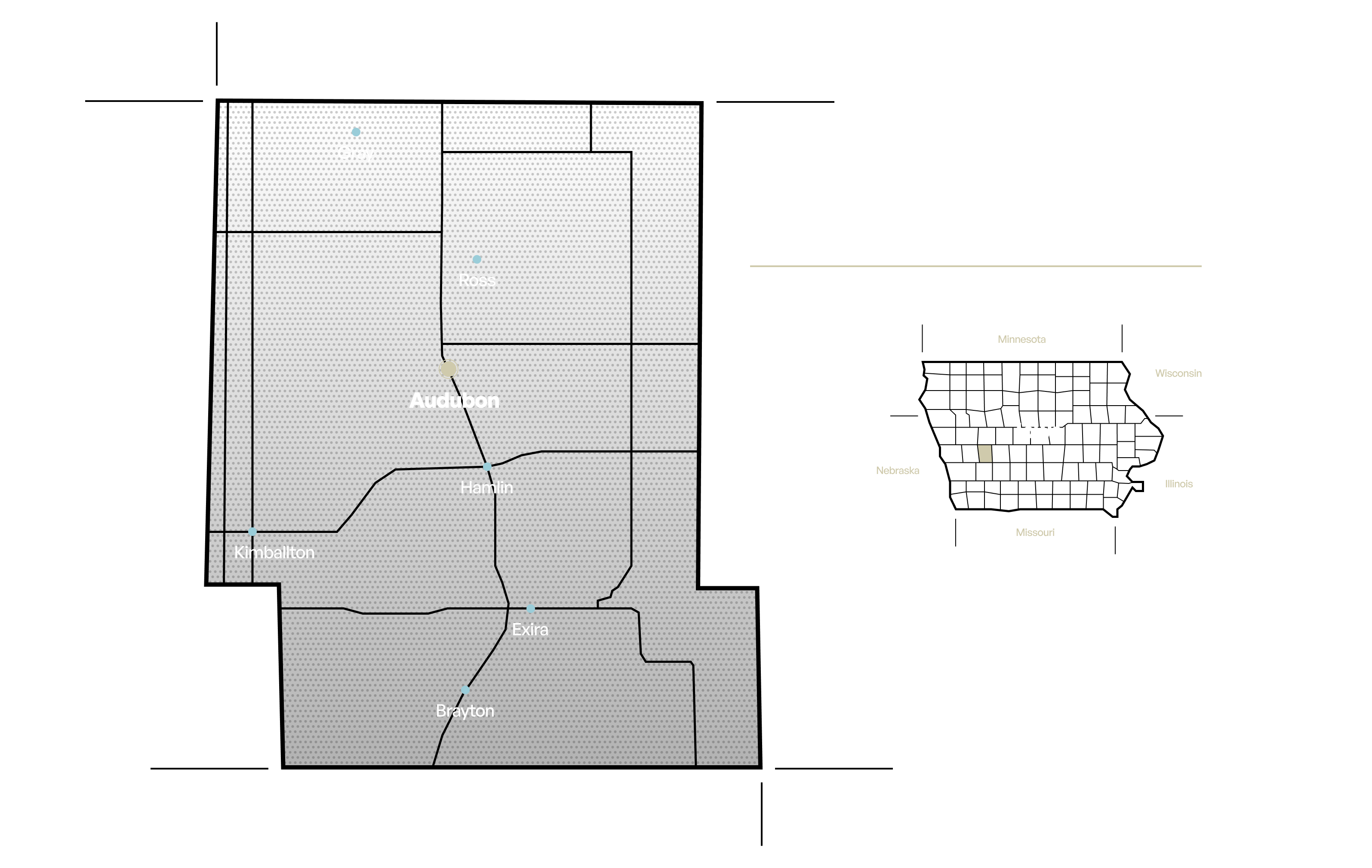
Audubon, Iowa
Snowfox Discovery has leased over 10,000 acres in Audubon County in 2026. Audubon sits directly above the Mid-Continental Rift, a massive, ancient geological structure with world-class potential for natural hydrogen generation.
Snowfox’s acreage is strategically located near major existing agricultural and ammonia infrastructure. This means any hydrogen Snowfox discovers can find a direct, local pathway into Midwestern markets, supporting regional farming and industry with clean, affordable fuel and feedstocks.
With the current land acquisition campaign complete, Snowfox will now move into a subsurface maturation phase to carefully prepare and de-risk a target ahead of a planned exploratory drilling campaign in 2027/2028.
1
1
2
3
4
5
6
7
8
1
,
0
1
2
3
4
5
6
7
8
0
0
1
2
3
4
5
6
7
8
0
0
1
2
3
4
5
6
7
8
0
s
1
1
2
3
4
5
6
7
8
1
0
1
2
3
4
5
6
7
8
0
x
$
1
1
2
3
4
5
6
7
8
1
/kg
Working towards net zero.
Snowfox's work in this area gives us confidence that natural hydrogen has the potential to be the least carbon-intensive source of hydrogen. Due to the way natural hydrogen is generated and will be produced, its carbon emissions are expected to be consistently low when compared to other manufacturing routes.
Backed by world-leading investors and institutions.





Frequently Asked Questions.

Natural hydrogen is generated in the continental crust when water reacts with common iron-rich volcanic rocks, forming iron oxide and hydrogen. Natural hydrogen is also formed when radioactive elements contained within rocks emit radiation that splits a water molecule into oxygen and hydrogen. The rocks react with the oxygen leaving hydrogen. Both processes can build up significant amounts of hydrogen on geological timescales.
Different geological combinations that generate and accumulate natural hydrogen can be found globally. Snowfox understands the processes that control these features and is identifying the most likely places to discover economically significant hydrogen resources.
It is only in the last decade that the amount of hydrogen generated by the Earth’s continents was realised. With awareness of society’s need to decarbonise, interest in naturally occurring hydrogen has increased. A hydrogen gas field discovered in Mali in 1987 has recently been developed to supply local power needs, demonstrating that natural hydrogen resources are a reality.
Snowfox modelling tells us so. Natural hydrogen production uses established technologies. It is projected to cost significantly less than hydrogen manufactured by electrolysis using wind or solar (green) hydrogen. Natural hydrogen competes on price with carbon-intensive ‘grey’ hydrogen, which is the predominant method of manufacture today.
Estimates vary substantially because we are still in the early stages of exploration. Snowfox expects only a fraction of the hydrogen generated in the continents to be trapped and preserved. However, because so much has been generated, even a small fraction will be enough to mitigate the current use of carbon-intensive 'grey' hydrogen.
Hydrogen behaves in a similar way to other gases. Once it has been generated in the Earth's crust, it rises towards the surface. Along the way it may become trapped by an impermeable layer of rock and accumulate underground, forming a gas field. It is accessed by drilling and produced from wells.
Yes. Modelling shows that natural hydrogen has the potential to have the lowest carbon intensity. This is because there is no need to manufacture the hydrogen by the chemical reactions required in ‘grey’ or ‘green’ hydrogen. Processes forming natural hydrogen in the Earth’s crust generate zero carbon. Natural hydrogen’s low emissions mostly come from the associated equipment and processes used to extract the hydrogen from the ground.
Today, hydrogen is a U$170bn industry, producing 95 million tonnes used per year. It is a vital, irreplaceable chemical feedstock for ammonia, methanol and in metal refining. Fertiliser produced from the ammonia contributes to feeding half of the global population. Tomorrow's hydrogen demand will significantly expand with an increased range of uses including as a clean-burning fuel.
